
Internal linking is one of those SEO fundamentals that everyone acknowledges matters, and almost nobody does well at scale. Ask any SEO professional what they’d optimize first on a large site if they had unlimited resources, and internal linking would be in the top three answers every time. Ask how many large enterprise sites have a truly optimized internal link architecture, and the honest answer is: almost none.
The reason isn’t a lack of effort. It’s a lack of framework. Traditional internal linking guidance — “link to relevant content,” “use descriptive anchor text,” “build content hubs with pillar pages” — is directionally correct but insufficiently precise to guide systematic optimization of a site with thousands of pages. And manually auditing internal links at that scale is essentially impossible.
Quantum SEO provides the framework that’s been missing. Dynamic internal linking, when structured according to quantum-inspired topical authority principles, transforms internal architecture from an afterthought into one of the most powerful authority amplification mechanisms available.
Why Static Internal Link Architectures Fail at Scale
Traditional internal linking is largely static. You build content hubs, create a handful of pillar pages, link related posts to each pillar, and call it done. This structure works reasonably well when your site has a few hundred pages organized around a handful of clearly defined topics.
The problems emerge at scale:
Topical drift — As sites grow over months and years, new content gets added without systematic integration into the existing link architecture. New pages sit in topical isolation, neither contributing to nor benefiting from the authority accumulation in related content clusters.
Link equity pooling in wrong places — Without active management, internal link equity tends to concentrate on a few high-linked pages (often the homepage and main category pages) while large swaths of topically valuable content sit link-starved and effectively invisible to Googlebot’s authority calculations.
Anchor text entropy — Over time, the anchor text used in internal links becomes inconsistent, reducing the semantic signal strength of the internal link profile. Different writers use different phrasing for the same concepts; links to the same destination use wildly varying anchor text.
Structural misalignment with semantic clusters — The site’s link architecture reflects its historical organizational decisions, which often don’t align with its current topical authority structure or with how search engines model the semantic relationships between its content.
Dynamic Internal Linking: The Core Concept
Dynamic internal linking, in a quantum SEO context, means two things.
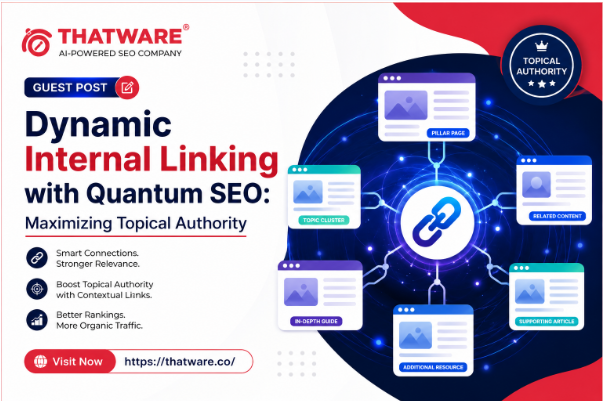
First, the internal link architecture is designed according to quantum-inspired topical authority principles rather than intuitive editorial judgment. This means treating the site’s internal link graph as a network optimization problem — using graph analysis, semantic vector mapping, and authority distribution modeling to design a link structure that maximizes topical authority concentration where it matters most.
Second, the architecture is maintained dynamically — continuously updated as new content is published, as topical clusters evolve, and as search intent patterns shift. Not a static structure built once, but an actively managed network that adapts to keep authority concentrated in the highest-value areas.
Dynamic internal linking Quantum SEO implementations combine these two elements to create internal link architectures that compound authority over time rather than degrading as the site grows.
The Graph Theory Underneath
The quantum-inspired approach to internal linking draws heavily on graph theory — the mathematics of networks — and specifically on concepts from quantum walk theory that describe how information and authority propagate through complex networks.
A few key principles:
Graph centrality and authority — In network analysis, a node’s centrality measures how central it is to information flow through the network. Pages with high centrality in your internal link graph accumulate more authority than pages with low centrality, regardless of their absolute number of inbound links. The goal of dynamic internal linking is to maximize the centrality of your semantically highest-value pages.
Cluster coefficient optimization — Dense clusters of interlinked pages within a topical area create constructive interference in quantum walk models, amplifying authority within the cluster. An optimal internal link architecture maximizes cluster coefficient within topical groups while maintaining efficient connections between clusters.
Hub and spoke topology — Pillar pages should function as true hubs — pages with significantly higher centrality than the cluster pages they connect. This means not just linking to pillar pages, but ensuring that pillar pages link back into the cluster in ways that create dense topical connectivity.
Bridge page optimization — In large site architectures, some pages function as bridges between topical clusters. These bridge pages deserve special attention in internal linking design — they’re the pathways through which authority flows between topic areas, and their connectivity determines how efficiently your site’s global authority distributes to individual topical clusters.
Implementation: Building a Dynamic Link Architecture
Actually building a dynamic internal link architecture requires a systematic process:
Step 1: Semantic cluster mapping — Identify the distinct topical clusters in your content inventory, using semantic vector analysis to group pages by topical proximity rather than by navigational category. These clusters often don’t align perfectly with your site’s navigational structure, which is usually revealing.
Step 2: Current link graph analysis — Map your existing internal link graph and analyze its topology. Where is link equity currently concentrated? Which high-value pages are link-starved? Which pages sit at the bridge positions between clusters? How does current centrality distribution map onto semantic priority?
Step 3: Anchor text audit — Analyze the anchor text distribution across your internal link profile. What semantic signals is your internal linking currently sending? How consistent is anchor text for your most important destination pages?
Step 4: Optimal architecture design — Using the semantic cluster map and link graph analysis, design the target internal link architecture. Which pages should have highest centrality? What cluster density is needed to create constructive interference in each topical group? Where should bridge pages be positioned?
Step 5: Implementation and monitoring — Execute the linking changes, prioritizing the highest-impact interventions first. Monitor semantic velocity, crawl coverage, and authority distribution changes as the new architecture takes effect.
Anchor Text Strategy in a Quantum Framework
Anchor text in dynamic internal linking deserves specific attention because it’s where most large-scale implementations fall short.
Quantum-inspired anchor text strategy recognizes that anchor text creates semantic network signals, not just individual link signals. When multiple pages link to the same destination using semantically coherent anchor text, the network-level signal is significantly stronger than the sum of the individual link signals. Constructive interference at work.
This means anchor text strategy needs to operate at the cluster level:
-
Identify the primary semantic concepts each pillar page should own
-
Ensure that anchor text across the cluster consistently reinforces these semantic associations
-
Avoid anchor text that creates semantic interference — links that associate a page with concepts outside its intended authority domain
For large sites, this typically requires automated anchor text audit tooling and content production guidelines that specify anchor text conventions by cluster. Manual implementation is too slow and too inconsistent at scale.
Measuring the Impact
Scalable Quantum SEO company implementations track internal linking impact through metrics that traditional SEO dashboards often miss:
Semantic velocity by cluster — How quickly are pages within a topical cluster gaining relevance scores across their target query space after internal linking improvements?
Link equity distribution efficiency — What percentage of the site’s total link equity is concentrated in semantic priority pages vs. low-value pages?
Orphaned page reduction — What percentage of the content inventory has meaningful internal link connections to the rest of the site?
Cluster cohesion scores — How dense is the internal linking within each topical cluster, relative to the theoretical maximum?
These metrics tell a much richer story about whether internal linking changes are actually producing the authority concentration effects they’re intended to produce.
The payoff for getting this right is significant. Well-implemented dynamic internal linking is one of the highest-leverage optimizations available for large sites — it affects crawl budget allocation, authority distribution, semantic signal coherence, and user navigation quality simultaneously. And because it compounds over time as the link graph matures, the investment in systematic implementation produces accelerating returns rather than one-time gains.